
Python Programming Training Classes in Jersey City, New Jersey
Training Suggestions from the Experts

An Experienced Python developer must have
... an understanding of the following topics: Map, Reduce and Filter, Numpy, Pandas, MatplotLib, File handling and Database integration. All of these requirements assume a solid grasp of Python Idioms that include iterators, enumerators, generators and list comprehensions.
To quickly get up to speed, we suggest you enroll in the following classes: Beginning Python and Advanced Python 3
Call for Details: 303.377.6176
Learn Python Programming in Jersey City, NewJersey and surrounding areas via our hands-on, expert led courses. All of our classes either are offered on an onsite, online or public instructor led basis. Here is a list of our current Python Programming related training offerings in Jersey City, New Jersey: Python Programming Training
Python Programming Training Catalog
subcategories
Web Development Classes
Course Directory [training on all levels]
- .NET Classes
- Agile/Scrum Classes
- AI Classes
- Ajax Classes
- Android and iPhone Programming Classes
- Azure Classes
- Blaze Advisor Classes
- C Programming Classes
- C# Programming Classes
- C++ Programming Classes
- Cisco Classes
- Cloud Classes
- CompTIA Classes
- Crystal Reports Classes
- Data Classes
- Design Patterns Classes
- DevOps Classes
- Foundations of Web Design & Web Authoring Classes
- Git, Jira, Wicket, Gradle, Tableau Classes
- IBM Classes
- Java Programming Classes
- JBoss Administration Classes
- JUnit, TDD, CPTC, Web Penetration Classes
- Linux Unix Classes
- Machine Learning Classes
- Microsoft Classes
- Microsoft Development Classes
- Microsoft SQL Server Classes
- Microsoft Team Foundation Server Classes
- Microsoft Windows Server Classes
- Oracle, MySQL, Cassandra, Hadoop Database Classes
- Perl Programming Classes
- Python Programming Classes
- Ruby Programming Classes
- SAS Classes
- Security Classes
- SharePoint Classes
- SOA Classes
- Tcl, Awk, Bash, Shell Classes
- UML Classes
- VMWare Classes
- Web Development Classes
- Web Services Classes
- Weblogic Administration Classes
- XML Classes
- DOCKER WITH KUBERNETES ADMINISTRATION
30 November, 2026 - 4 December, 2026 - ASP.NET Core MVC, Rev. 8.0
19 October, 2026 - 20 October, 2026 - RED HAT ENTERPRISE LINUX SYSTEMS ADMIN I
26 October, 2026 - 30 October, 2026 - RED HAT ENTERPRISE LINUX AUTOMATION WITH ANSIBLE
9 November, 2026 - 12 November, 2026 - RED HAT ENTERPRISE LINUX SYSTEMS ADMIN II
2 November, 2026 - 5 November, 2026 - See our complete public course listing
Blog Entries publications that: entertain, make you think, offer insight
Facebook was originally intended as a way for people to stay in touch with friends and family members by sharing pictures and status updates on their timeline. As the website's popularity has grown, so has criticism that it is becoming one giant, online high school.
Online Bullying
 There has been a dramatic increase in recent years in the number of online bullying cases due to the introduction of social media. Bullying isn't just limited to younger Facebook users, either. Many adult users have also resorted to bashing others online through nasty status updates and cruel comments.
Prior to social media, bullying in high school involved "kick me" signs and toilet swirling. Facebook and other social media outlets have allowed users to take bullying to a whole other level. Victims can no longer escape bullying by leaving school or work. The torture continues online, at anytime and anyplace.
Status "Likes"
In high school, everyone wants to be part of the popular crowd; people who are outgoing, beautiful, and seem like they have everything. Posting a status update is similar to wanting to be popular. Once an update is posted, many users wait with bated breath to see how many friends will "like" their status. They believe that the more "likes" they receive, the more popular they are.
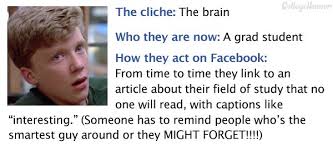 If that isn’t enough, there are many Facebook games that involve "liking" someone's status. Games like "Truth Is", where someone likes a status update and in return the poster writes how they really feel about the friend on their Facebook wall. This can get touchy, especially if the two people aren't friends outside of Facebook. It's similar to high school where someone desperately wants another person to like them, but when they find out how that person really feels they are crushed.
Relationships Are Difficult to Keep Private
When someone signs up for Facebook they’re asked to complete their profile, which includes a relationship section. Users can select from different options including "single", "married", "widowed", and "divorced". Whenever someone changes their relationship status, the update shows up on each of their friend's news feeds.
It's easy to see how this feature correlates with high school where everyone talks about who is dating who or which couple broke up. It used to be that after graduation, people were able to keep their relationships more to themselves. Not so anymore in the age of social media. Now everyone has the ability to state their opinion on a friend's relationship status, either by "liking" their status change or by commenting on it.
 Facebook has presented many benefits to its users, including the ability to rekindle old high school friendships. What one must understand when they sign up for the service is that they are opening themselves up to the same criticism and drama that takes place in a high school setting.
Proceed with caution!
Learning SQL development can seem like an overwhelming task at first. However, mastering just a few key points will help ease your way through 80 percent of the day-to-day challenges when writing stored procedures and solving common problems. Here are three important SQL development factors to keep in mind:
Outer Joins
One of the most crucial things to understand in SQL server are joins. Joins are a way to retrieve data from two or more tables based on logical relationships between them. Joins dictate how Microsoft SQL Server ought to use data from one table to select the rows in another table.
In my experience inner joins are intuitive while outer joins can present additional hours of grief by overlooking associations in the other table(s). The outer join is the key to answering questions about what the database does not have. For example, if you need to make a query to display all the students who are without report-cards, you’ll need a left join to get all students coupled with a “where clause” to return the ones who have nulls for their report card table columns in the results.
Many talented Java script programmers have muddled through the SQL Server by deficient coding around the inner join. As a result, their queries can take five hours to run, whereas, properly written left joins, can take only two seconds to run.
Aggregation
Grouping results comes up in SQL a lot more than you might think. Knowing how to write a query when answering questions such as, “What’s the average grade for each teacher’s student list?” is invaluable. This kind of question cannot be answered with a single table or solely by joins. You’ll often find you need to use joins in conjunction with group by statements. Always write the raw query first and then look at the results. Next, you have to figure out the best way to group them, rewrite your select clause and add a group by clause in the end.
Digging Through Data
I find this is the most lacking skill in many programmers. In fact, many otherwise-talented programmers holding Master’s Degrees fail to get jobs because they couldn’t analyze rows of data objectively during interviews. It’s just something that’s not taught but is crucial to get under you belt. Why? Eventually, some query is not going to perform as you may expect. And, the only way to find discrepancies is to look at rows of data, identify what join isn’t finding a match or where bad data is throwing things into chaos. Get familiar with how joins actually work, even if you have to manually walk through the logic of a large stored procedure’s tree of joins. It’s boring and time-consuming but absolutely necessary.
Take the time to master the core skills that will make you a successful SQL Programmer and avoid queries that run for five hours!
Memory management is always a priority in pretty much any programming language you would want to use. In the lower level languages such as C, there are a number of functions which help you manage the memory your application uses, but they are not the easiest to use. Some of the more modern programming languages such as Python, Ruby, Perl, and of course the subject of this article, Javascript all have a built in feature called garbage collection.
Garbage collection essentially means that the languages compiler will automatically free the memory being occupied by unused variables and objects, but there is no telling when this could occur. It is purely down to the compiler to decide when the garbage collection process should be initiated.
HP is taking legal action against Oracle for allegedly breaching its 2010 partnership agreement of porting HP’s core software products with the latest versions of Itanium. In March, Oracle announced it would not be developing any new versions for products designed for the Itanium processor. Itanium has the ability to power the so-called Business Critical Systems hardware for extremely demanding enterprise applications. However, Oracle said the chip line is about to die.
The companies’ lawyer met in the Santa Clara County Superior Court with Judge James Kleinberg presiding to discuss their side of the event. Others in the courtroom included Ann Livermore, HP board member and former enterprise business chief, and Oracle’s co-President Safra Catz. Catz and Livermore were the two key negotiators for the agreement. Livermore was to testify later in the day. Kleinberg is set to rule if the companies had a legally binding contract.
Jeff Thomas, HP’s lawyer, focused on the so-called Hurd Agreement wording, where the companies reiterated their partnership after Oracle hired Mark Hurd, former CEO for HP. HP also sued Hurd for breaking the confidentiality agreement.
Thomas and the lead lawyer for Oracle focused on one paragraph of the agreement, which read Oracle would continue to provide its product suite on the HP platform in a way that’s consistent with the existing partnership before Hurd’s hiring.
Tech Life in New Jersey
| Company Name | City | Industry | Secondary Industry |
|---|---|---|---|
| HCB, Inc. | Paramus | Retail | Office Supplies Stores |
| Wyndham Worldwide Corp. | Parsippany | Travel, Recreation and Leisure | Hotels, Motels and Lodging |
| Realogy Corporation | Parsippany | Real Estate and Construction | Real Estate Agents and Appraisers |
| Church and Dwight Co., Inc. | Trenton | Manufacturing | Manufacturing Other |
| Curtiss-Wright Corporation | Parsippany | Manufacturing | Aerospace and Defense |
| American Water | Voorhees | Energy and Utilities | Water Treatment and Utilities |
| Cognizant Technology Solutions Corp. | Teaneck | Computers and Electronics | IT and Network Services and Support |
| The Great Atlantic and Pacific Tea Co. - AandP | Montvale | Retail | Grocery and Specialty Food Stores |
| COVANCE INC. | Princeton | Healthcare, Pharmaceuticals and Biotech | Pharmaceuticals |
| K. Hovnanian Companies, LLC. | Red Bank | Real Estate and Construction | Architecture,Engineering and Design |
| Burlington Coat Factory Corporation | Burlington | Retail | Clothing and Shoes Stores |
| GAF Materials Corporation | Wayne | Manufacturing | Concrete, Glass, and Building Materials |
| Pinnacle Foods Group LLC | Parsippany | Manufacturing | Food and Dairy Product Manufacturing and Packaging |
| Actavis, Inc | Parsippany | Healthcare, Pharmaceuticals and Biotech | Pharmaceuticals |
| Hudson City Savings Bank | Paramus | Financial Services | Banks |
| Celgene Corporation | Summit | Healthcare, Pharmaceuticals and Biotech | Biotechnology |
| Cytec Industries Inc. | Woodland Park | Manufacturing | Chemicals and Petrochemicals |
| Campbell Soup Company | Camden | Manufacturing | Food and Dairy Product Manufacturing and Packaging |
| Covanta Holding Corporation | Morristown | Energy and Utilities | Energy and Utilities Other |
| New Jersey Resources Corporation | Wall Township | Energy and Utilities | Gas and Electric Utilities |
| Quest Diagnostics Incorporated | Madison | Healthcare, Pharmaceuticals and Biotech | Diagnostic Laboratories |
| Rockwood Holdings Inc. | Princeton | Manufacturing | Chemicals and Petrochemicals |
| Heartland Payment Systems, Incorporated | Princeton | Financial Services | Credit Cards and Related Services |
| IDT Corporation | Newark | Telecommunications | Wireless and Mobile |
| John Wiley and Sons, Inc | Hoboken | Media and Entertainment | Newspapers, Books and Periodicals |
| Bed Bath and Beyond | Union | Retail | Retail Other |
| The Children's Place Retail Stores, Inc. | Secaucus | Retail | Clothing and Shoes Stores |
| Hertz Corporation | Park Ridge | Travel, Recreation and Leisure | Rental Cars |
| Public Service Enterprise Group Incorporated | Newark | Energy and Utilities | Gas and Electric Utilities |
| Selective Insurance Group, Incorporated | Branchville | Financial Services | Insurance and Risk Management |
| Avis Budget Group, Inc. | Parsippany | Travel, Recreation and Leisure | Rental Cars |
| Prudential Financial, Incorporated | Newark | Financial Services | Insurance and Risk Management |
| Merck and Co., Inc. | Whitehouse Station | Healthcare, Pharmaceuticals and Biotech | Pharmaceuticals |
| Honeywell International Inc. | Morristown | Manufacturing | Aerospace and Defense |
| C. R. Bard, Incorporated | New Providence | Healthcare, Pharmaceuticals and Biotech | Medical Supplies and Equipment |
| Sealed Air Corporation | Elmwood Park | Manufacturing | Plastics and Rubber Manufacturing |
| The Dun and Bradstreet Corp. | Short Hills | Business Services | Data and Records Management |
| The Chubb Corporation | Warren | Financial Services | Insurance and Risk Management |
| Catalent Pharma Solutions Inc | Somerset | Healthcare, Pharmaceuticals and Biotech | Healthcare, Pharmaceuticals, and Biotech Other |
| Becton, Dickinson and Company | Franklin Lakes | Healthcare, Pharmaceuticals and Biotech | Medical Supplies and Equipment |
| NRG Energy, Incorporated | Princeton | Energy and Utilities | Gas and Electric Utilities |
| TOYS R US, INC. | Wayne | Retail | Department Stores |
| Johnson and Johnson | New Brunswick | Healthcare, Pharmaceuticals and Biotech | Pharmaceuticals |
| Automatic Data Processing, Incorporated (ADP) | Roseland | Business Services | HR and Recruiting Services |
training details locations, tags and why hsg
The Hartmann Software Group understands these issues and addresses them and others during any training engagement. Although no IT educational institution can guarantee career or application development success, HSG can get you closer to your goals at a far faster rate than self paced learning and, arguably, than the competition. Here are the reasons why we are so successful at teaching:
- Learn from the experts.
- We have provided software development and other IT related training to many major corporations in New Jersey since 2002.
- Our educators have years of consulting and training experience; moreover, we require each trainer to have cross-discipline expertise i.e. be Java and .NET experts so that you get a broad understanding of how industry wide experts work and think.
- Discover tips and tricks about Python Programming programming
- Get your questions answered by easy to follow, organized Python Programming experts
- Get up to speed with vital Python Programming programming tools
- Save on travel expenses by learning right from your desk or home office. Enroll in an online instructor led class. Nearly all of our classes are offered in this way.
- Prepare to hit the ground running for a new job or a new position
- See the big picture and have the instructor fill in the gaps
- We teach with sophisticated learning tools and provide excellent supporting course material
- Books and course material are provided in advance
- Get a book of your choice from the HSG Store as a gift from us when you register for a class
- Gain a lot of practical skills in a short amount of time
- We teach what we know…software
- We care…